
Forum Replies Created
- AuthorReplies
 DaveParticipant
Why do our sources speak so despairingly about dogs?
In the morning lesson yesterday, the article spoke about how a dog and a donkey is lower than a beast. What does this mean? I remember the teaching that, generally speaking, what is written does not refer to anything in this world. Can you open this up for me a little bit?
DaveParticipantHow does the ego come to submission under spirituality?
The ego, with its slippery and insidious nature, is a beastly inclination that seems to define our very existence. I find the word “insidious” particularly fitting, because it is literally defined as “proceeding in a, gradual, subtle way, but with harmful effects.”
The question that lingers in my mind is this: How does the ego ultimately yield to the influence of spirituality?
Authentic sources have conveyed to me that our objective is not to completely eliminate the ego, but rather to redirect its intention. As I delve into these teachings, I am increasingly conscious of the pervasive presence of egoism in my own life, dominating almost every aspect. Reflecting on moments when my egoism flared up (ie. satisfying myself at the cost of the other), I often wonder if there could have been an alternative reaction, or if it was truly impossible to behave differently.
This leads me to ponder whether egoism in spirituality simply dissolves and aligns with spiritual intentions, or if it assumes a new, imperceptible state beyond my current understanding?
DaveParticipantI’ve learned about prayer from Kabbalah, that only a true prayer is answered. Which comes from a place of absolute need, deficiency. A prayer that is not meant to change the world to fit my needs, but to ask the Creator to change me. But my prayers don’t ever seem to work. What am I doing wrong? Am I looking in the wrong direction for the answer? I keep on coming up to this roadblock.
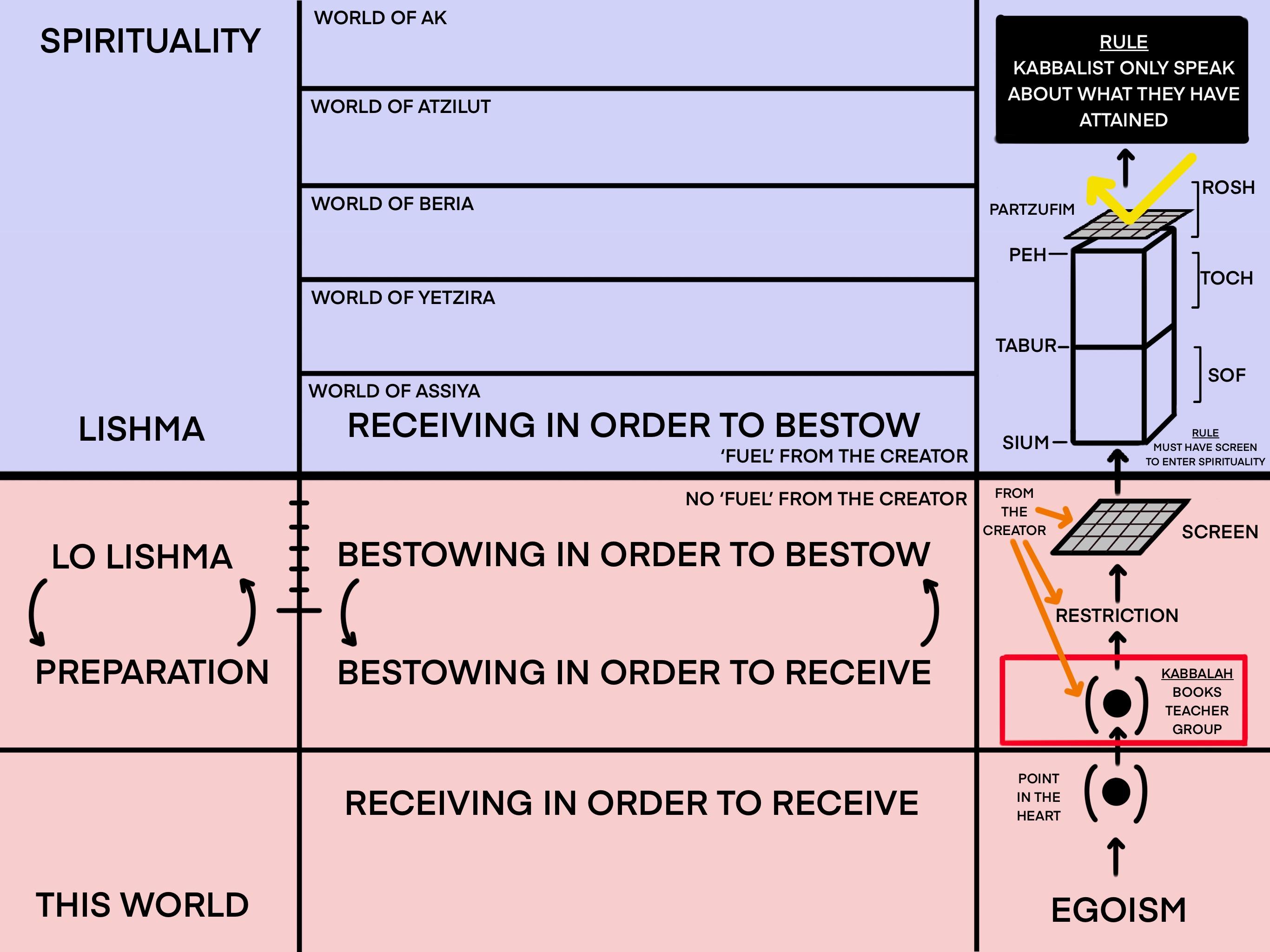
DaveParticipantIn many of the Kabbalah lessons from this school, there is a recurring emphasis on refraining from creating visual representations of God. My interpretation of this teaching is rooted in the belief that such depictions stimulate our intellect/ego but do not necessarily contribute to real spiritual growth. Interestingly, I’ve observed that this school frequently employs schematics, diagrams, and illustrations as teaching tools for spirituality. Personally, I find myself deeply drawn to this method of instruction because it resonates with me on a profound level.
Rather than viewing these diagrams as mere intellectual stimulants, I see them as symbolic arrows pointing us towards a deeper feeling of the Creator. I’ve even had dreams of transforming these diagrams into sculptures. However, this apparent contradiction between the teachings against graven images and the use of visual aids in our spiritual journey raises some questions for me.
When is it acceptable to create visual representations in the pursuit of spiritual enlightenment, and when does it cross the line into forbidden territory?
DaveParticipantI’ve noticed a common thread in the questions posed by various students, all converging on a central theme: our current stage in the spiritual journey. This leads me to ponder the following questions.
Is our desire to pinpoint our spiritual stage inherently egotistical, or is it a necessary and integral aspect of our journey? Could there be drawbacks to this desire, and should we perhaps shift our focus entirely towards bestowing to my friend, especially my friend in the group of ten? Or is this intense desire for the study simply the yearning and the purpose is unconscious drawing of the reforming light?
In this initial preparatory phase do we engage with a provisional, ‘training wheels’ type of Screen during our ‘Lo Lishma’ phase. Does this initial Screen, fueled by our own efforts and aspirations, serve as a preparatory stage before we receive the ‘real’ Screen from the Creator?
Does our spiritual journey progress out of preparation to a stage where our longing for The Creator intensifies to such an extent that it leads us to self-restraint (a conscious restriction)? At this transformative juncture, are we bestowed with an authentic Screen, signifying the maturation of our heart’s point into a true spiritual form (a Partzuf), thereby marking our genuine entry into spirituality? Is this understanding broadly accurate? Also, great job on your Q&A session!
 DaveParticipant
I’ve been diving into Lesson 11 of Pticha with KabU past lessons, where a humorous yet insightful analogy caught my attention. Daniel raised a question about the concept of free choice. You responded with a clever parable: imagine fish debating the nature of dryness—a condition entirely alien to their underwater existence.
These fish enthusiastically try to convince each other about the wonders of dryness, despite having no real grasp of it: “dryness?! yeah, it’s great!”. They even muse about what it might be like under a rock or at the water’s surface, all the while circling around the concept of dryness as if it was something within their reach. This analogy was a humorous way to show how we, much like the fish, grapple with the abstract idea of free choice. You explained that true free choice exists in a perfect balance of giving and receiving, in a specific state known as the middle third of Tifferet, and that while this concept is complex, we approach it through our environment.
The story and the discussion were not only amusing but also illuminated the nuanced path to understanding free choice. It’s these moments that make the educational journey at KabU so fantastic. Thank you!

- AuthorReplies